

Editorially Independent: We may earn a commission from links on this page, at no extra cost to you. Our conclusions and analysis are always our own.
Most content teams are trapped in fragmented workflows: keyword research in one platform, drafting in another, optimization somewhere else, and distribution handled manually across disconnected systems.
The result is slower publishing cycles, inconsistent SEO execution, and content operations that become difficult to scale profitably.
This AI content marketing workflow solves that problem by combining research, AI-assisted drafting, semantic SEO optimization, branded visual creation, and automated distribution into a unified operational framework. Instead of relying on isolated tools, modern teams can now execute a complete SEO-driven publishing workflow in under 90 minutes while maintaining quality, consistency, and search performance.
The Core AI Content Stack
This workflow is powered by a specialized stack of AI content marketing tools, each solving a different operational bottleneck in the publishing lifecycle. Together, these platforms streamline research, drafting, semantic SEO optimization, branded asset creation, and automated distribution into one scalable content execution system.
Teams building scalable publishing systems should also review our breakdown of the best AI SEO tools for semantic optimization, rank tracking, content scoring, and workflow automation.
| Stage | Tool | Why It Wins |
|---|---|---|
| Ideation & Research | SE Ranking | Builds your strategy on proven, data-backed ideas. |
| Drafting | Rytr | Delivers high-quality drafts with unmatched speed & value. |
| Optimization | NeuronWriter | Ensures every article is perfectly tuned to rank. |
| Visuals | Picsart | Creates professional, on-brand visuals in minutes. |
| Distribution | Ocoya | Amplifies reach with automated, intelligent distribution. |
Ideation & Research
Tool
Why It Wins
Builds your strategy on proven, data-backed ideas.
Drafting
Tool
Why It Wins
Delivers high-quality drafts with unmatched speed & value.
Optimization
Tool
Why It Wins
Ensures every article is perfectly tuned to rank.
Visuals
Tool
Why It Wins
Creates professional, on-brand visuals in minutes.
Distribution
Tool
Why It Wins
Amplifies reach with automated, intelligent distribution.
The 5 Stages of the AI Content Marketing Workflow
Stage 1: Data-Driven Ideation with SE Ranking
Every successful content strategy begins with data, not guesswork. This stage is about identifying what your audience is actively searching for and analyzing competitor weaknesses. We recommend trying SE Ranking to ensure every piece of content is built on a foundation of proven demand.
- Key Actions: Identify high-volume, low-competition keywords; analyze the top-ranking content for strategic gaps; build a content calendar backed by SERP data.
- Why It Matters: An effective AI content strategy eliminates wasted effort. This data-driven approach ensures you are creating content that people actually want and that is positioned to rank from day one.
➡Related: Best AI SEO Tools in 2026
Stage 2: High-Velocity Drafting with Rytr
The “blank page” is the single biggest killer of content marketing productivity. This stage is about generating a high-quality, well-structured first draft in minutes, not hours. Rytr is one of the most efficient AI content writing tools for this exact purpose.
- Key Actions: Use specific templates for blogs, social posts, or emails; input your topic and key points; generate a professional draft.
- Why It Matters: Speed and value. Rytr removes the primary bottleneck in the content process, allowing you to focus your time on refining and enhancing the draft rather than starting from scratch.
➡ Compare: Jasper vs Rytr
Stage 3: SEO Optimization with NeuronWriter
A good draft is not enough; it must be perfectly optimized to compete in the SERPs. This stage involves the scientific process of AI content optimization, aligning your draft with the specific topical and semantic signals Google is rewarding for your target keyword.
- Key Actions: Use semantic analysis of top-ranking pages; follow real-time content scoring for on-page factors; incorporate NLP-driven term suggestions.
- Why It Matters: This stage bridges the gap between writing and ranking. NeuronWriter ensures your content is not only well-written, but also semantically aligned with search intent, competitive NLP entities, and the topical signals required to compete for Page 1 rankings.
➡Related: The Best SEO Writing Tools in 2026
Stage 4: Enhancing Engagement with Branded Visuals
Content without visuals is easily ignored. This stage is about increasing the engagement, shareability, and memorability of your article by adding professional, on-brand graphics. We recommend Picsart for its speed and powerful template library.
- Key Actions: Create custom hero images, infographics, or charts from templates; apply brand colors and fonts; export in web-ready formats.
- Why It Matters: High-quality visuals can dramatically increase reader retention and social sharing, making every piece of content work harder for your brand.
➡ Deep Dive: Read Our Full Picsart Review →
Stage 5: Automated Distribution with Ocoya
Publishing an article is only half the battle. This final stage focuses on content marketing workflow automation, transforming your single blog post into a multi-channel campaign. Ocoya automates this process, amplifying your reach with minimal effort.
- Key Actions: Schedule your post across all major social platforms; use AI to generate channel-specific captions; track performance with integrated analytics.
- Why It Matters: Automated content creation and distribution ensures maximum exposure for every asset you produce. Ocoya turns a “publish once” event into a sustained promotional effort, driving more traffic back to your site.
Assembling Your AI Content Stack: A Tool for Every Stage
Each platform below supports a specific execution layer of the AI content lifecycle, helping teams move from ideation and drafting to optimization, branding, publishing, and automated distribution with significantly less friction.
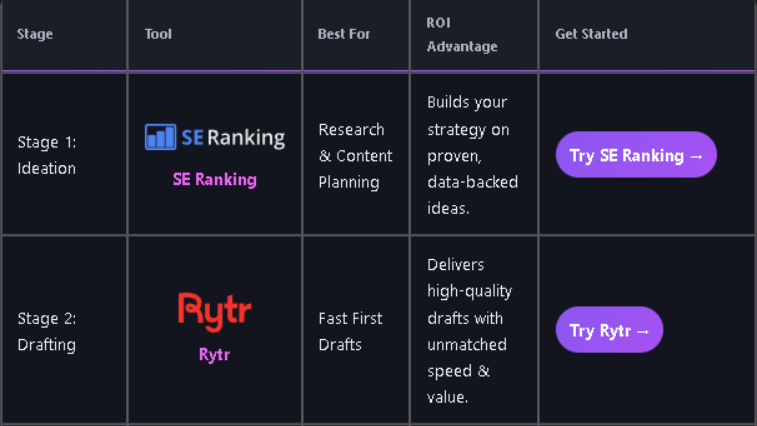
| Stage | Tool | Best For | ROI Advantage | Get Started |
|---|---|---|---|---|
| Stage 1: Ideation | Research & Content Planning | Builds your strategy on proven, data-backed ideas. | Try SE Ranking → | |
| Stage 2: Drafting | Fast First Drafts | Delivers high-quality drafts with unmatched speed & value. | Try Rytr → | |
| Stage 3: Optimization | SEO Content Alignment | Ensures every article is perfectly tuned to rank. | Try NeuronWriter → | |
| Stage 4: Visuals | Branded Graphics | Creates professional, on-brand visuals in minutes. | Try Picsart → | |
| Stage 5: Distribution | Social Publishing | Amplifies reach with automated, intelligent distribution. | Try Ocoya → |




Stage 1: Ideation
Best For
Research & Content Planning
ROI Advantage
Builds your strategy on proven, data-backed ideas.
Stage 2: Drafting
Best For
Fast First Drafts
ROI Advantage
Delivers high-quality drafts with unmatched speed & value.
Stage 3: Optimization
Best For
SEO Content Alignment
ROI Advantage
Ensures every article is perfectly tuned to rank.
Stage 4: Visuals
Best For
Branded Graphics
ROI Advantage
Creates professional, on-brand visuals in minutes.
Stage 5: Distribution
Best For
Social Publishing
ROI Advantage
Amplifies reach with automated, intelligent distribution.
The Final Verdict: Your 90-Minute Content Engine
This is not just a theoretical framework. Teams implementing structured AI content marketing workflows consistently outperform teams relying on disconnected tools and manual execution.
A modern AI workflow dramatically reduces friction between ideation, drafting, optimization, branding, and distribution. What once required a full day of coordination can now be executed in under 90 minutes using integrated AI-assisted systems.
The real advantage is not simply speed. It is operational consistency. Businesses using repeatable AI workflows publish more frequently, maintain stronger SEO alignment, and scale high-quality content production without proportionally increasing workload.
For agencies, publishers, and growth-focused marketing teams, combining research intelligence, AI drafting, semantic optimization, branded visuals, and automated distribution creates a compounding advantage that becomes increasingly difficult for competitors to replicate.
🏆 Final Takeaway: The highest-performing content teams no longer rely on fragmented publishing systems. They operate unified workflows that combine research, drafting, optimization, branding, and distribution into one scalable execution engine.
Explore the Best AI SEO Tools →
Frequently Asked Questions
What is the best AI content marketing workflow?
The best workflow is an integrated, five-stage process. It begins with data-driven ideation (SE Ranking), moves to high-speed drafting (AI content writing tools like Rytr), followed by crucial AI content optimization (NeuronWriter), is enhanced with custom visuals (Picsart), and is completed with content marketing workflow automation for distribution (Ocoya).
Can AI completely replace a human content marketer?
No. An effective AI content strategy doesn’t replace the strategist; it accelerates the executor. AI handles the repetitive, time-consuming tasks of drafting, optimizing, and distributing. The human marketer’s role becomes more strategic: setting the direction, refining the final output, and ensuring the content aligns with the brand’s unique voice and objectives.
How can I ensure my AI-generated content is high quality?
The key is to treat AI as a co-pilot, not an autopilot. Start with a data-driven brief, use a high-quality AI for content creation tool for the first draft, and always use a dedicated optimization tool like NeuronWriter to align the content with search intent. The final step is always a human review to add nuance, brand voice, and final polish.
What are the best AI tools for content marketing?
The best AI content marketing tools typically combine keyword research, AI writing, semantic SEO optimization, branded visual creation, and automated publishing workflows. Platforms like SE Ranking, Rytr, NeuronWriter, Picsart, and Ocoya each specialize in a different stage of the content lifecycle.
How do AI SEO tools improve rankings?
AI SEO tools improve rankings by helping teams identify keyword opportunities, optimize semantic relevance, analyze competitors, improve topical coverage, and streamline technical SEO workflows. Many platforms also use NLP analysis to align content with search intent more effectively.
Can AI automate content distribution?
Yes. Modern AI workflow platforms can automate content scheduling, social media distribution, caption generation, campaign management, and performance monitoring across multiple channels simultaneously.
What is the fastest AI writing workflow?
The fastest AI content workflows combine keyword research, AI-assisted drafting, semantic optimization, visual generation, and automated publishing into a connected operational process rather than relying on isolated tools.
Which AI tools help with semantic SEO optimization?
Platforms like NeuronWriter and Surfer SEO help improve semantic SEO by analyzing NLP entities, topical relevance, competitive content structures, and optimization signals that influence search engine rankings.
See the Full Toolkit
For a complete breakdown of the best AI content marketing tools on the market, including our deep-dive reviews and rankings, see our flagship guide.
➡️ Read Next: The Best AI Writing Assistants of 2026